


“Why am I not getting any better?”
A deeper guide for music production on Mac is available here: logicpros.net.
Audio workflow note: for podcast editing, this Sound Forge Pro for podcasters gives producers a useful next step.
It is the universal cry of the bedroom guitarist, the basement producer, and the living-room pianist. Every self-taught musician asks this eventually. You’ve been at it for months – maybe years.
You can play the songs you learned in your first six months with your eyes closed. You’ve even written a few of your own. But somewhere along the way, the progress curve didn’t just slow down; it flattened. You’re putting in the hours, your calluses are thick, but the “needle” isn’t moving.
Here is the uncomfortable truth: more time rarely solves it. If you are stuck, it’s likely because you’ve fallen into the “Experience Trap.” We often confuse doing something with getting better at it. In 1993, psychologist K. Anders Ericsson and his colleagues published a landmark study in Psychological Review comparing three groups of violinists.
The “best” group had accumulated an average of 7,410 hours of deliberate practice by age 18, while the “least accomplished” group had just 3,420. But the kicker wasn’t just the math; it was the structure. The top tier didn’t just play more; they played differently.
Ericsson defined deliberate practice as activity with a well-defined goal, requiring high concentration, and most importantly – immediate feedback. This is fundamentally different from “noodling,” which is enjoyable but essentially keeps you running in place.
The self-taught path has massive strengths. A study by Peter MacIntyre and Gillian Potter in Psychology of Music found that informal learners often have higher musical self-esteem and are twice as likely to write original music.
You have instincts that formal students often have “schooled” out of them. But your blind spot is feedback. Without it, repetition doesn’t lead to progress – it leads to calcification.
If you’re stuck, it’s almost certainly a gap in one of these five areas.
Tool 1: Ear Training

You can’t play what you can’t hear. This sounds like a Zen koan, but it’s a mechanical reality. Every note you second-guess, every chord you can’t name by sound, and every melody you struggle to transcribe is actually an ear problem masquerading as a technique problem.
Many self-taught players treat their instrument like a typewriter: “If I press this button, this sound happens.” But that’s a mechanical relationship, not a musical one. When you train your ear, you stop reacting to the instrument and start commanding it.
A Northwestern University study published in Nature Neuroscience found that musical training significantly enhances the brainstem’s sensitivity to sound – the brain’s auditory system, once thought to be fixed and unchangeable, actually reshapes itself in response to musical experience.
Why it breaks the plateau:
When your ear is sharp, you stop needing tabs. You can hear a song on the radio and “know” the chord progression because you recognize the movement. This allows you to jam with others on the fly and write melodies that actually fit the harmony instead of just guessing.
- The 15-Minute Rule: Don’t do “marathon” ear training. Use a Functional Ear Trainer or SoundGym for 15 minutes a day. Neuroplasticity depends on repeated, spaced activation.
- Active Transcribing: Pick a simple nursery rhyme or a basic pop melody. Try to find the notes on your instrument without looking up the sheet music. It will be frustrating for the first week. By the third week, it will feel like a superpower.
Tool 2: Structured Practice
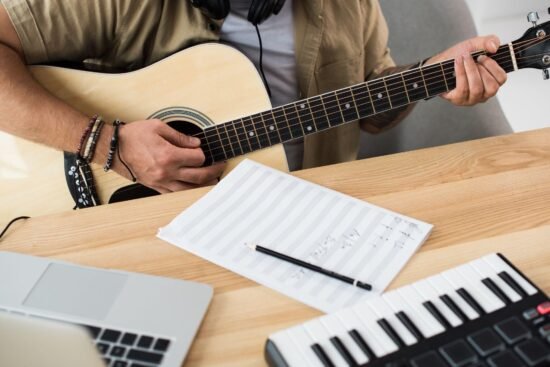
An unstructured practice session is usually just a jam session in disguise. If you sit down, play three songs you already know, “noodle” over a blues scale for twenty minutes, and then put the instrument away, you haven’t practiced. You’ve performed for your furniture.
Indiana University professor Pete Miksza ran a study published in Psychology of Music comparing two groups of wind players over five days. Both groups learned standard practice techniques – slow practice, chunking, repetition.
But the second group also received training in self-regulation strategies: goal-setting, planning, self-evaluation, and deliberate reflective pauses. By Day 5, the self-regulation group made significantly greater gains within the exact same 20-minute practice window. Not more time. Not more talent. Just a clearer target before they picked up the instrument.
The “Three-Block” framework:
If your practice always feels comfortable and sounds polished, you’re likely staying within what you already know. Real improvement comes from pushing into areas that challenge you – where some parts may still sound rough while you figure them out.
- The Warm-Up (10 mins): Get physically ready – loosen up your fingers, breath, or voice so you can play or sing freely.
- The Drill (20 mins): Focus on one clearly defined weakness. Not “play faster,” but something precise like: “nail this 4-bar transition at 90 BPM without mistakes.” This is the part that should challenge you.
- The Creative Reward (15 mins): Apply what you just worked on. Turn that scale, technique, or passage into something musical – like a short riff, melody, or improvisation.
A 2025 systematic review in the Journal of Intelligence found that practice quality mattered far more than practice quantity – musicians who planned, monitored, and reflected on each session improved significantly more than those who simply repeated material.
Tool 3: Targeted Theory
Most self-taught musicians view music theory like tax law: boring, restrictive, and complicated. They fear that learning theory will “kill their soul” or make them sound like a robot.
In reality, theory is just a map. If you’re lost in a city, a map doesn’t tell you where you have to go; it tells you where you can go. Without it, every compositional decision is trial and error. You spend three hours looking for “that one chord” that sounds right. With theory, you know it’s a secondary dominant, and you find it in three seconds.
A 2025 study in the International Journal of Literature and Arts found that musicians who integrated theory into their training showed higher creative output and more confidence in improvising.
How to learn it without dying of boredom:
Don’t study theory as a general project. Study it in response to a problem.
- Stuck in a rut? Look up “Diatonic Harmony” to understand why certain chords go together.
- Solos sound like scales? Look up “Targeting Chord Tones.”
- Bridges feel weak? Study “Modulation.”
Use resources like Signals Music Studio on YouTube, which teaches theory through the lens of actual songwriting rather than academic abstraction. Their series on chord function is a particularly good starting point for self-taught players who learn better by doing than by reading textbooks.
Tool 4: Occasional Expert Feedback

One of the biggest problems with learning on your own is that you don’t have someone to guide you. You’re judging your playing using your own ears, which can be biased. You might think your timing is good, but a professional could notice that you’re actually playing a bit too fast on the beat.
A 2022 study in Music Education Research interviewed professional musicians and found that even at the highest levels, they viewed external feedback as a “calibration tool.” Playing and monitoring are competing cognitive demands; you literally cannot hear yourself accurately while you are trying to play.
The “One-on-One” Lesson:
You don’t need a weekly teacher. Many self-taught players avoid lessons because they don’t want the commitment. Instead, treat a teacher like a consultant.
- Book one session on a specific problem: “I can’t get this rhythm right,” or “My hand hurts when I play barre chords.”
- A single hour with a pro can fix a technical flaw that might have otherwise taken you five years to realize on your own.
Budget-friendly options are easier to find than most people think. Platforms that connect you with vetted one-on-one music lessons let you book a targeted session, so you get expert eyes on your specific problem exactly when you need it.
Tool 5: Recording as a Daily Discipline

If you aren’t recording yourself, you are practicing in the dark. Recording is the only way to hear what you actually sound like, rather than what you think you sound like.
A 2024 study in Research Studies in Music Education compared musicians who reviewed audio playback of their own performances against a control group who received no playback.
Only 14% of participants in the playback group remained unchanged in their self-assessment after listening back. 49% identified specific weaknesses they had not noticed while playing.
37% actually rated themselves better than they had felt at the moment. In either direction – harsher or more forgiving – what you believe is happening while you play is regularly disconnected from what is actually on the recording.
The Workflow:
- Voice memo: Record your 20-minute practice session. Don’t listen right away. Play it the next day. With fresh ears, you’ll notice hesitation, missed notes, and timing issues.
- The Monthly Archive: Once a month, record a full song. Save it. When you feel like you aren’t progressing six months from now, listen back to that recording. It is the only objective proof of your growth.
Conclusion
The plateau you’re facing right now isn’t a ceiling. It’s a signal – your current system has stopped teaching you anything new, and unlike talent, systems can be changed.
Each of these five tools addresses a different breakdown in the feedback loop that makes practice productive.
Ear training closes the gap between what you hear and what you play. Structured practice turns scattered time into targeted improvement. Theory hands you a vocabulary so you stop guessing and start deciding.
Expert feedback gives you an outside perspective you genuinely cannot replicate on your own. And recording makes the invisible visible – it turns vague feelings of progress (or stagnation) into something you can actually measure.
Most self-taught musicians don’t fail because they lack talent or discipline. They fail because they keep practicing the same way and expect different results. The ones who break through don’t just put in more hours, they get honest about what isn’t working and deliberately fix it.
Pick one tool, commit to it for a month, and pay attention to what changes. Not just in how you play, but in how you think about playing. That shift – from player to student of your own playing, is where real progress begins.