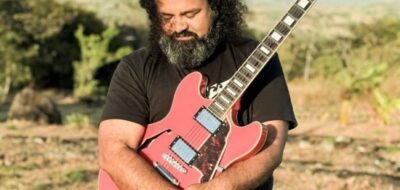


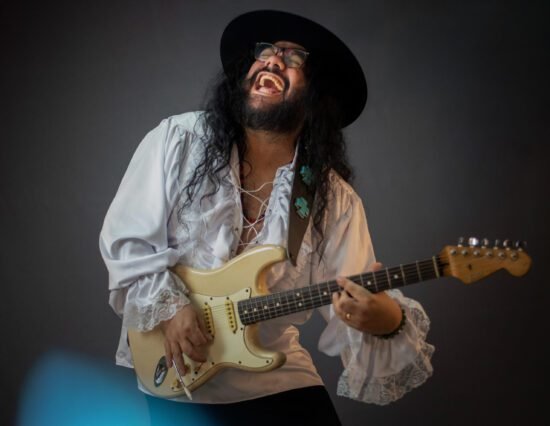
There are those artists that make music and then there are those that truly live their music. Our friend Antonio Vergara is one of the latter. His music is an extension of who he is. The Grammy nominated artist took the time to chat with us about his immersion into his sound and his newest record Vergara Street.
Enjoy the interview here:
First off, what is it that pushes you to create music?
What drives me to create music is born from an inner need that never rests. From a very young age, I understood that music was not merely a means of entertainment, but a way to give meaning to the human experience — to turn memory into sound and transform wounds into a shared language. Every chord, every lyric, is an act of translating life itself: the silent battles we fight, the hope that refuses to die, and the dignity that remains even when everything seems lost.
I’m not motivated by fame or recognition, but by the urgency to tell stories that would otherwise be buried in the noise of everyday life. When I pick up a guitar, I feel that music becomes a kind of bridge between the intimate and the collective: what I have lived or witnessed also becomes part of those who listen. That is the greatness of art — it transcends individuality and becomes community.
Music, to me, is a territory of freedom. It allows me to break away from rigid structures, imposed silences, and the invisible chains that so often limit us. Every song is a form of resistance, but also a form of tenderness, because within the rawness that blues can express, there is always space for hope, redemption, and emotional memory.
What drives me to create music is the conviction that art can transform the way we see the world and ourselves. Writing, playing, and producing are not isolated acts — they are my way of having a dialogue with time, with the past generations who brought me here, and with the future ones who will find in these songs a testimony that we were here, that we fought, dreamed, and loved.
How would you describe the Antonio Vergara sound?
Describing my sound is like talking about a crossroads where tradition and rebellion coexist. I’m not interested in repeating established formulas, but in creating spaces where blues — the root and heart of what I do — can converse with modernity, with the voices of the streets, with the pulse of the city, and with the echo of memory.
The sound I seek always starts from the guitar, because there I find an omnipresent narrator. In my hands, the guitar is not just an instrument; it’s a witness that carries the voices of those who walked before and those still searching for their place in the world. Between riffs that bleed emotion, phrases that breathe rawness, and silences that speak as much as notes, I try to build a language that’s recognized for its honesty rather than its perfection.
I use the resonator, the lap steel, and the electric guitar as tools to expand that voice. Each one contributes a different texture, and together they create a sonic spectrum that doesn’t aim to fit within rigid categories but to embrace the complexity of being human. The resonator connects me with the primitive — with the echo of the land and labor; the lap steel takes me to almost spiritual territories, where anguish turns into prayer; and the electric gives me the strength of asphalt, the rage and hope of those who refuse to give up.
My sound is the sum of all those contrasts: lament and celebration, wound and scar, the weight of silence and the euphoria of a shout. I want every song to sound like a living portrait — with the rawness of the street and the poetry of something that still dreams of transcending.
Which artists have had the biggest influence on your career?
Talking about influences is talking about an emotional and sonic map that has always accompanied me. On one hand, there are the great blues icons — those figures who could bare their souls with a single chord and who taught me that music is truth before it is technique. I grew up listening to artists who understood blues as a testimony of life, as a confession turned into song, and from them I learned that vulnerability can be the greatest form of strength.
But my influences aren’t limited to the established legends. The streets, ordinary people, the sounds of the city, and the silences of the countryside have been just as decisive as any historic record. I’m inspired by a street vendor’s call, the hum of a factory shutting down, the improvised song of someone unaware they’re creating art. Those invisible elements slip into my music and become part of my sound.
It has also been crucial that I’ve assumed a comprehensive role in my music. I’m not just a guitarist or a singer — I’m the producer, engineer, and composer of all my records. That has allowed me to consolidate a unique style, because from the first idea to the final mix, what you hear is a coherent vision, without intermediaries diluting the original intent. That creative control gives me freedom, but also great responsibility: every chord, every word, every silence has a reason to exist.
One of the defining moments in my path was my GRAMMY® nomination. Standing in that symbolic space, where so many of my heroes had been, confirmed that my sound had found its place within the memory of contemporary blues. I didn’t see it as a finish line, but as a reminder that the language I’ve been building can stand shoulder to shoulder with the history of the genre while becoming part of the industry’s most important stages.
How does a song come together for you? Tell us about your songwriting process.
In my case, songs don’t arise from a fixed routine or a premeditated ritual. Usually, ideas appear unexpectedly, without me looking for them. It’s not like that cliché artists often mention in interviews, where they “wait for inspiration.” In my experience, music surprises me: it often starts with a guitar riff or a melody that appears instinctively. That’s the starting point — a spark that opens the path.
From there, something very particular happens: I feel that the lyrics come to me like whispers, as if someone were quietly dictating them in my ear. It’s not a rational process at first, but more of an act of inner listening, of letting the words fall where they’re meant to. Then, calmly and with discipline, I move into the stage of polishing — shaping the lyrics, ensuring that what they convey remains true to the initial emotion that brought them into being.
As a producer, the process takes on another dimension. I’m very methodical and like working with clear concepts. For me, an album isn’t just a collection of songs, but a work that must have a strong narrative and identity. From the very start, I think about the overall concept, the atmosphere, the story I want to tell. That concept evolves as the songs come to life, and the beautiful thing is that, in the end, they all converse with each other like chapters in the same book.
That’s exactly what happened with Vergara Street. This album was born from the idea of portraying the street as a symbolic stage — a place where struggle, memory, pain, and hope intersect. Each song is a corner of that street, a story that adds a new shade to the collective experience. Some tracks speak about the dignity of work, others reveal the harshness of exclusion, and others capture moments of redemption and nostalgia. As a producer and songwriter, what I sought was to create a sonic map of that imaginary street which, in truth, is the sum of all our streets — the ones we walk and the ones we carry within.
So when someone listens to Vergara Street, they’re not just hearing an album — they’re walking through a space of memory and struggle, where the guitar becomes a storyteller and every lyric leaves a trace as real as a footprint on the pavement.
Your latest album has really caught some attention. What can you tell us about Vergara Street?
Vergara Street is not just an album — it’s a statement of identity and a collective portrait. It represents the point where music becomes a mirror of life, where contemporary blues turns into an urban chronicle of those who walk day after day among asphalt, memory, and hope.
Musically, this record marks a natural expansion of my language. After my GRAMMY® nomination, I felt the need to delve even deeper into what defines me — that fusion of tradition and modernity, of the spiritual and the earthly. Vergara Street was born from that tension: between wound and redemption, between what pain leaves behind and what music can rebuild. Every riff, every chord was conceived with narrative intent. Nothing is random; everything responds to a conceptual thread that runs through the record like a sonic film.
Personally, this project is perhaps the most intimate I’ve ever made — not because it speaks directly about me, but because it contains my vision of the world. Vergara Street is the street we all walk: the street of the worker who doesn’t give up, the dreamer who stumbles but keeps going, the children who inherit both the scars and the dreams of their parents. It’s also a tribute to anonymous people, to voices that rarely have a microphone, to stories that never make headlines but are the soul of our cities.
As a producer, I wanted every sonic detail to reflect authenticity. The guitar, the resonator, the lap steel — each instrument acts as a different narrator within the same story. The sound textures, vocal layers, and rhythmic nuances are designed so that the listener doesn’t just hear but feels they’re walking down that street, covered in its dust and breathing its air.
In essence, Vergara Street is an invitation to look closer — to realize that behind everyday noise there’s poetry; that amid urban chaos, beauty still exists; and that blues — when lived truthfully — can remain a tool of redemption and resistance. This album doesn’t aim to please; it aims to move. And if, by the end, someone feels that something inside them has shifted, then the street has fulfilled its purpose.
What do you hope the listener takes away from an Antonio Vergara album?
What I most hope is that Vergara Street won’t just be listened to — but lived. That whoever immerses themselves in the album feels as though they’ve walked through a real place, full of voices, memories, wounds, and beauty. This record is conceived as a symbolic street, a metaphor for life itself: at some point, we’ve all walked our own “Vergara Streets” — those spaces where struggle and hope intersect, where love coexists with loss, and where dignity holds on even when the world seems to fall apart.
Musically, I wanted each song to have the power of a scene — riffs as footsteps, lyrics as the lights and shadows of that street, and the guitar — in all its forms — as the voice that connects everything. As a composer and producer, I worked to ensure the album remained coherent but emotionally deep — that each listen reveals something new, that every chord has purpose.
If there’s something I want to remain in the listener, it’s the certainty that music is still a refuge. That contemporary blues is not nostalgia, but a living language that can speak of the present, our cities, and our personal stories. In Vergara Street, the street isn’t just a setting — it’s a mirror, reflecting our contradictions, fears, and longings.
Each song is written to remind us that even when circumstances change, something remains: our capacity to resist, to reinvent ourselves, and to keep walking. Because in the end, we’re all wanderers on the same street, trying to find meaning amid the noise.
If, after listening to Vergara Street, someone feels they’ve walked through their own inner streets — where faith, loss, love, and memory collide — then the music will have fulfilled its purpose. The street isn’t just mine; it belongs to all who dare to listen with their hearts.
You are involved in more than just music. How do you tie in your work as a lawyer, university professor, and cultural advocate?
I’ve never seen my work as separate compartments. For me, music, teaching, law, and cultural advocacy are all part of the same path. They feed one another because they share a common root: the belief that knowledge and art have the power to transform lives.
As a lawyer, I learned to observe reality with a critical eye and to understand that behind every law and social structure are human stories that deserve to be heard and respected. That perspective inevitably shapes my music: when I compose, I’m also speaking of justice, memory, and dignity — even if I do so through a guitar instead of a courtroom.
As a university professor, I’ve experienced the dialogue with generations seeking answers and needing role models who inspire them to think differently. That responsibility — to teach, to transmit — becomes a motivation that also flows into my songs. Each album, in a way, is an open classroom: a space for reflection where the listener can question, recognize, and find new meanings.
And as a cultural advocate, I’ve sought to ensure that the artist’s voice doesn’t stay only on stage, but resonates in the spaces where the future of culture is shaped. I firmly believe that art must have a place in public policy, education, and daily life, because that’s where it truly fulfills its social role.
That commitment is also what led a university to award me an Honoris Causa Doctorate in Music, Science, and Art — an honor I deeply value, not as a personal achievement, but as recognition of a lifelong mission to show that music is not isolated entertainment but a bridge between disciplines, an educational tool, and a language that converses with science and society.
That’s why I always say that Antonio Vergara the musician, the professor, the lawyer, and the cultural advocate are not different people — they’re expressions of the same pursuit. And Vergara Street reflects all of that: a work that combines poetry, memory, discipline, and emotion, proving that art can be creation, education, and awareness all at once.
How do you see the evolution of contemporary blues, and where do you think your work fits within it?
Blues, more than a genre, is a universal language that has managed to adapt to every era without losing its truth. What has always fascinated me is its ability to evolve without betraying its roots. I believe the challenge for any contemporary artist is precisely that: to respect the essence of the blues — its original spirit of honesty and resistance — while placing it in a new context where it can engage with today’s realities.
For many years, I’ve worked on that pursuit, trying to understand how to keep its soul alive without turning it into a museum piece. My approach has always been one of research and conscious experimentation. It’s not about altering the nature of the blues but expanding its territory — opening it to new narratives, new sound textures, new emotional geographies. The goal is not to imitate the past but to prolong its spirit, to make it breathe within current languages.
That was the foundation of my artistic proposal, and it’s what the Recording Academy recognized when my work was nominated for a GRAMMY®. That nomination meant much more than personal success — it was confirmation that contemporary blues is still alive, that it can renew itself and continue to move new generations. At the same time, it was a historic milestone: I became the first Hispanic and Ibero-American artist ever nominated in the Best Contemporary Blues Album category. That recognition marked a turning point because, for the first time, a voice from our language and region entered a space traditionally dominated by the Anglo-American world.
I believe this proves that blues doesn’t belong to one place or culture. Its spirit transcends borders. Today, more than ever, blues is being rewritten from different accents, languages, and experiences — and that diversity enriches it. In my case, I try to make my music a bridge between the roots and the present — a way to honor what blues was and to project what it can continue to be.
My place within that evolution is that of an active witness — someone who listens, studies, and respects history, but also feels the need to push it further, to open new paths. Because if blues has taught us anything, it’s that freedom is never inherited — it’s conquered every time you play a note with your soul.Your guitar work has a very distinctive voice.
How would you describe your relationship with the instrument?
My relationship with the guitar goes far beyond the technical aspect. It’s an emotional, almost spiritual bond. From my earliest years, I felt that the instrument could express everything that words sometimes fail to. For me, the guitar is an extension of the body, but above all, of the soul — it’s the channel through which music becomes testimony, dialogue, and confession.
Over time, that connection has grown and expanded into different forms of the instrument. The electric guitar, the resonator, and the lap steel are three distinct voices within my sonic universe. Each one plays a role, each one expresses a different shade of the same emotion.
The electric guitar allows me to translate the strength of asphalt, the tension of urban life, the roar of the streets that inspired Vergara Street. With it, I can build dense textures, riffs that hit hard, and solos that aim not for virtuosity but for truth. The resonator, on the other hand, brings me back to the primitive — to the roots of the blues, the sound of dust and iron, that mix of rawness and beauty that exists only when the instrument is played with hands weathered by time.
Then there’s the lap steel guitar, which has become one of the most expressive tools in my language. I use it as a bridge to another level of interpretation — a space where melody becomes almost human. The lap steel allows me to sing through the strings, slide between notes like breaths, and generate a type of expressiveness that borders on the spiritual. In my solos, that instrument takes me beyond the physical limits of a conventional guitar; it allows me to reach that place where sound becomes pure emotion — free of barriers or artifice.
Every time I play, I feel the guitar doesn’t just accompany my songs — it narrates them. It’s a voice that understands silence, that translates pain, that answers the questions left open by the lyrics. And in the context of Vergara Street, that guitar — in all its forms — becomes another character: a chronicler walking down the street alongside every story, shouting, crying, or simply breathing with them.
Ultimately, my relationship with the guitar is one of constant dialogue. I don’t play to show off; I play to reveal. And in every note, I try to make not only my story heard, but also the story of everyone who has found in music a way to exist.