

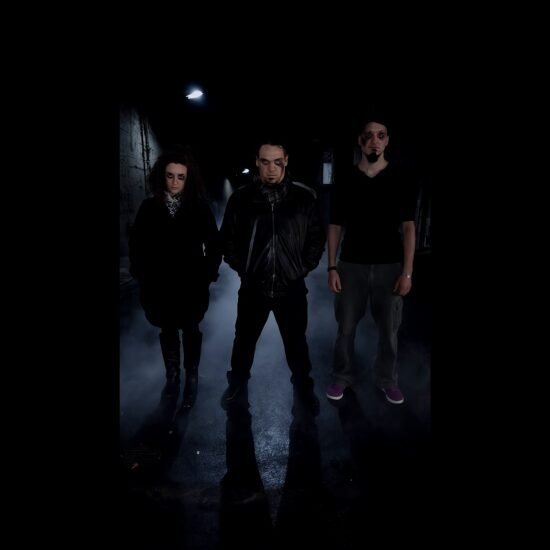
Some music is meant to entertain. Our recent find EPTA7 seems more interested in getting inside your head. The Irish-Italian industrial metal and dark alternative project creates a cinematic world filled with paranoia, trauma, ghosts, strange creatures, and distorted realities. We caught up with the band to talk about their return, the unsettling universe behind Here Come the Freaks, and where all those fears lead next. Enjoy the interview here:
After originally forming EPTA7 in Dublin in 2012, there was a long hiatus before returning in 2026. What brought the project back to life?
EPTA7 never really died. It was more like something we left sleeping for a very long time.
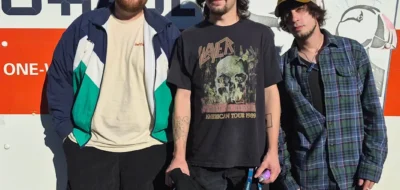
We started the project in Dublin in 2012 and released our first demo, Eptasystem, in 2014. At that time, there were four of us — myself, Miss Grey, BP Snow, and Dave Peach — and we had already started developing many of the ideas that would eventually become Here Come the Freaks.
Then life simply took us in different directions. Miss Grey and I moved from Dublin to Cork, while BP Snow and Dave remained in Dublin, and keeping the project alive became increasingly difficult. Eventually, EPTA7 went into a very long state of hibernation.
But we never completely let go of those songs. The recordings, ideas, and unfinished material stayed with me for all those years.
At the beginning of 2026, things changed when we met Industrial Fog. We started working together on the old material, initially almost as an experiment, and suddenly we realised that those songs still had something to say. Technology had also changed enormously since 2014, so we had possibilities that simply didn’t exist when we originally recorded them.
From there, everything happened very naturally. We didn’t want to recreate EPTA7 exactly as it was in 2014. We wanted to take the original ideas, preserve their identity, and finally turn them into what we had imagined all those years ago.
So Here Come the Freaks is technically our debut album, but in a strange way, it took more than ten years to make. Some of its ghosts have been following us since Dublin.
Latest album “Here Come the Freaks” explores fears, trauma, paranoia, and distorted perceptions through dark imagery. Where did this surreal world come from?
We think most of it came from the idea that the scariest things are not necessarily the ones that exist outside of us. Sometimes they are the things we create inside our own minds.
Here Come the Freaks is very much about that. Fear, trauma, anxiety and paranoia can completely change the way we perceive reality. A room is still the same room, a city is still the same city, but when you look at them through fear, everything can become hostile or distorted. That’s where a lot of the surreal imagery on the album comes from.
We wanted to give those feelings a physical form. Walls breathe, cities seem alive, ghosts walk among people, monsters appear, and reality constantly feels like it’s about to collapse. But most of these things are metaphors. The real monsters are often our fears, memories, obsessions and the things we carry around inside ourselves.
That’s also why there is a strange mixture of horror and melancholy throughout the album. We didn’t want to create horror just for the sake of being dark or disturbing. There is always something human behind it.
In a way, Here Come the Freaks is like walking through somebody’s mind at three o’clock in the morning, when reality, memories, fears and imagination all start bleeding into each other.
Industrial metal, post-punk, dark electronic music, and industrial rock all find their way into EPTA7’s sound. How do you decide which elements belong in a particular song? Is there freedom in the songwriting?
Absolutely. Freedom is probably one of the most important things in EPTA7.
We never start writing a song thinking, “This has to be industrial metal” or “This needs to sound more electronic.” Usually, we start with an idea, a riff, a rhythm, an atmosphere or even just an image, and then we let the song tell us where it wants to go.
That’s why the songs on Here Come the Freaks can be quite different from one another. Some are heavier and more aggressive, others are darker, more electronic or melancholic. We don’t really care if a particular element comes from industrial metal, post-punk, electronic music or somewhere completely different. If it serves the atmosphere and the story of the song, then it belongs there.
We think putting too many rules around songwriting can kill some of its personality. EPTA7 has a recognisable identity, of course, but we don’t want that identity to become a cage.
For us, the important thing is that when all these different elements come together, the result still feels like EPTA7. That’s the only rule we really have.
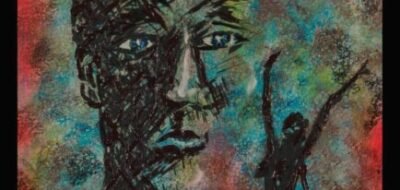
Official Music Video For “The Walls Breathe” By EPTA7
The album has a strong cinematic and a psychological-horror atmosphere. Were there specific films, books, artists, or real-life experiences that influenced the way you created its sound and imagery?
Definitely. We have always been attracted to dark and surreal imagery, not only in music but also in cinema, literature and visual art. Our influences are actually quite personal: H.P. Lovecraft has probably had the biggest influence on my imagination, while Miss Grey has always been particularly influenced by Tim Burton. Guillermo del Toro is a huge influence on both of us. H.R. Giger is certainly part of that visual universe too, although probably to a lesser extent.
I have also always loved horror films and role-playing games like Call of Cthulhu, where atmosphere and psychological tension are often much more important than simply showing you the monster. I think that idea has found its way into EPTA7 as well. What you don’t completely understand is often much more disturbing than what you can clearly see.
Cinema has influenced us in some very specific ways too. There’s actually a reference in the video for The Walls Breathe that, as far as I know, nobody has spotted yet. The sequence where the character walks through these endless corridors, surrounded by breathing walls, and eventually reaches a seemingly normal room with a table and a lamp was inspired by the final part of Stanley Kubrick’s 2001: A Space Odyssey. Dave Bowman’s journey takes him through something vast and incomprehensible before he suddenly finds himself in this strangely familiar, almost domestic environment.
We played with that same contrast in The Walls Breathe. After all the impossible corridors and organic, breathing architecture, you suddenly arrive somewhere that looks normal: a table, a lamp, something almost comforting. But that normality is only an appearance. Behind it, the impossible world is still there. In a way, it’s the familiar sitting on top of the monstrous.
But Here Come the Freaks isn’t built only from fictional influences. A lot of it comes from real life: fears, difficult experiences, relationships, isolation, anxiety, memories and the strange ways our minds process what happens to us. We take those very human feelings and exaggerate them until they become something almost cinematic.
That’s probably where the EPTA7 imagery comes from. Reality gives us the emotion, and then imagination transforms it into breathing walls, fog, ghosts, distorted cities and monsters.
For us, horror is not really about monsters. The monster is just a way of giving a face to something that was already there.
Is there a particular song on “Here Come the Freaks” that you feel best represents what EPTA7 is all about? What makes that track stand out to you? Why should a new listener check it out first?
If we had to choose just one, we would probably say The Walls Breathe.
Not necessarily because I think it’s the best song on the album — that’s almost impossible for me to decide — but because it contains many of the elements that define EPTA7 in one place. You have the heavy industrial side, the electronics, the groove, the contrast between different vocal approaches, but also that darker, more atmospheric and cinematic dimension that is extremely important to us.
Conceptually, it represents Here Come the Freaks very well too. The idea of being trapped in a place where something familiar suddenly becomes alive and threatening is basically the whole philosophy of the album condensed into one song. The walls are breathing, but you never really know whether they are actually breathing or whether the person experiencing it is losing their perception of reality.
That’s EPTA7 in a nutshell: something recognisable and almost familiar that gradually becomes strange, uncomfortable and surreal.
We also think it’s a good first track for someone discovering us because it’s quite immediate. You don’t necessarily need to understand the whole concept behind it to enjoy the song, but if you want to look deeper, there’s another layer underneath — and then another one.
At the same time, I wouldn’t want somebody to hear The Walls Breathe and think, “Okay, now I know exactly what EPTA7 sounds like.” The rest of Here Come the Freaks goes in several different directions. So maybe The Walls Breathe is the entrance to the building — but once you’re inside, there are a lot of other rooms.
Your music often blurs the line between what is real and what is imagined. How important is that uncertainty to the full EPTA7 experience?
It’s extremely important. In fact, I think uncertainty is one of the fundamental elements of EPTA7.
We don’t really want to tell the listener, “This is real, this isn’t, and this is exactly what the song means.” I think the moment you explain everything, you remove part of the mystery. We prefer to leave doors open and let people decide what they are seeing or hearing.
That’s also very connected to fear. When you know exactly what something is, you can start understanding it and dealing with it. But when you’re not sure whether something is real, imagined, remembered or distorted by your own mind, it becomes much more unsettling.
And that’s something we try to reproduce both musically and visually. Sometimes something appears completely normal, but there’s one detail that doesn’t belong there. Then another one. Eventually, you’re no longer sure where reality ended and something else began.
But I also like the fact that this gives the listener freedom. Two people can listen to the same EPTA7 song or watch the same video and come away with completely different interpretations, and neither of them necessarily has to be wrong.
Maybe that’s the full EPTA7 experience: we create the world and give you some clues, but we don’t give you the map.
We hear you are already working on the next project “Schengen Reload,” which moves away from internal fears toward wider contemporary social anxieties. What is the development and direction between these two projects?
We see Schengen Reload as a natural evolution of Here Come the Freaks, but on a much larger scale.
Here Come the Freaks looks inward. It’s about personal fears, trauma, paranoia, memories and the way fear can distort an individual’s perception of reality. With Schengen Reload, we take that same idea and apply it to society. What happens when fear is no longer individual, but collective? What happens when entire societies begin to see the world through fear?
The last few years have given us plenty of material: the pandemic, wars returning to Europe, climate change, growing social division, populism, nationalism and the return of borders — not only physical borders, but psychological ones too.
And Schengen Reload definitely has a point of view. We’re not interested in party politics, but we do believe in the idea of a united Europe. I think Europe has reached a point where going backwards into nationalism and isolation would make us weaker, not stronger. The challenges we’re facing are simply too big for every country to retreat behind its own borders and pretend it can deal with them alone.
That’s where the title comes from. Schengen is obviously associated with open borders and freedom of movement, but for us it also represents a much bigger idea: countries choosing cooperation over separation. At the same time, we don’t want to simply celebrate the Europe that already exists. “Reload” is there for a reason. Maybe what we need isn’t the old Schengen, but a new one — a new version of that idea, adapted to a world that has changed dramatically.
So the connection between the two albums is actually fear. In Here Come the Freaks, fear transforms the individual. In Schengen Reload, we explore what can happen when fear transforms societies — when it makes people build walls, search for enemies and believe that isolation will somehow make them safer.
Musically, the scale becomes bigger as well. We want to keep the EPTA7 identity, but the world we’re describing is broader, more chaotic and more confrontational, and the music naturally reflects that.
Here Come the Freaks asks what fear can do to a person. Schengen Reload asks what fear can do to all of us — and whether the answer is to build more walls, or finally understand that we are stronger together.
After spending years away from EPTA7 and finally releasing your debut full-length, what do you want listeners to take away from “Here Come the Freaks”—and where do you see the future of the project?
More than anything, We hope people can find something of themselves in Here Come the Freaks.
Behind all the monsters, breathing walls, ghosts and surreal imagery, this is actually a very human album. It’s about fears, memories, trauma, isolation and all those things we sometimes carry inside without really knowing what to do with them. We gave those feelings strange shapes and turned them into our own little universe, but the emotions behind them are real.
I don’t necessarily want listeners to understand the album exactly the way we do. Actually, I prefer the opposite. If somebody listens to one of these songs and connects it to something completely different in their own life, then the album has become theirs as well. That’s much more interesting to me than giving people a definitive explanation.
On a personal level, releasing this album also meant finally closing a circle that had been open for more than ten years. These songs survived Dublin, Cork, different periods of our lives and a very long silence. For years, Here Come the Freaks was something unfinished that was always somewhere in the background. Now it finally exists in the form we wanted it to exist.
But strangely enough, finishing it didn’t feel like the end of EPTA7. It had exactly the opposite effect.
We’re already working on Schengen Reload, we’re developing new visual ideas, and we want the visual side of EPTA7 to become increasingly important. We’re not interested in simply releasing an album, disappearing for a few years and then coming back with another one. We want to keep building this universe through music, videos and imagery, with each project adding another piece to it.
After such a long hibernation, I think we’ve done enough sleeping.
EPTA7 is awake now.